Tuesday, March 2, 2021

tiny book reviews (2021): two years eight months and twenty-eight nights, by salman rushdie

 Two Years Eight Months and Twenty-Eight Nights (Rushdie novel).png

Sometimes you're in the middle of a book and it's just so good that you don't really want to pick it up again because you know the more you read the less of it you'll have. 

Sometimes you're in the middle of a book and it's just good enough that you can't wait to get done doing whatever you're doing that's keeping you from the book so you can get back to it.

Sometimes you're in the middle of a book and it's interesting enough, but maybe not quite the right thing for right now so you pick something else up instead. You know you'll finish it, just not right now.

And sometimes you're in the middle of the book and you hate it. And you hate that you hate it, but you still hate it. And you're fully committed to finishing the book, because that's who you are--you're a person who finishes books--but holy. cow. this. book. is. just. so. bad.

For me, Two Years Eight Months and Twenty-Eight Nights was that book. 

...

Honestly, I'm sure Salman Rushdie has written good stuff. He's a super well-respected author. One doesn't just _become_ that for nothing. But this particular book, for this particular reader, had nothing.

I read this book because Rushdie got a lot of mentions in Homeland Elegies. And I've never read any Rushdie. And I'm old enough to remember the controversy over The Satanic Verses (though I didn't really know any more about it or him than that). So I figured I'd read some Rushdie.

Two Years Eight Months and Twenty-Eight Nights was what was available at my library. 

It's fantasy, I guess. Maybe you'd call it magical realism. Or someone might. A bit more magical than real, I think.

I got the sense that it was a parable of sorts. Or a retelling of some real history through myth. I think that's the point of magical realism. I didn't much care for One Hundred Years of Solitude because I didn't understand enough real Columbian social history to get it. I felt the same way reading this, except I didn't even know what continent I was on. 

And so I finished thinking that the book wasn't really written for me. It might be a great book...for a different reader. 

Then again, it may just be a crappy book.

It'll be a while before I can give Rushdie another try, but I will (probably with Midnight's Children). 

I feel like there's something here I need to know, like a dirt road you see meandering up that one particular draw--you trust there must be something up there and it's probably pretty awesome, but for whatever reason you've just never gone. 

Though, that might be the wrong metaphor--it might be that there's a whole other forest that I know next to nothing about, and that I've got to learn quite a bit more about that particular ecosystem before I can come to appreciate Rushdie trees.

I don't know. But I'll find out.

1 of 5 stars.

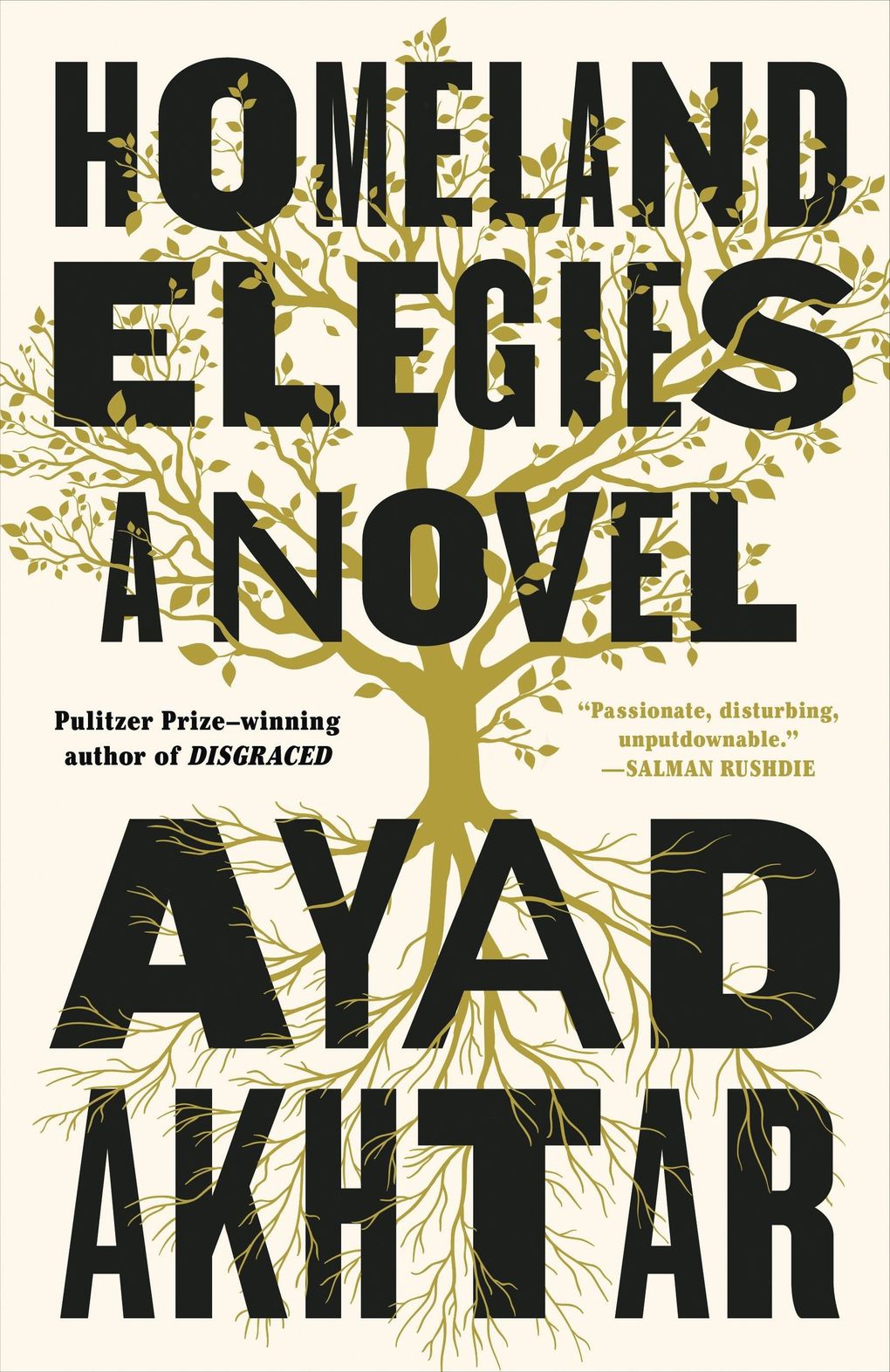
tiny book reviews (2021): homeland elegies, by ayad akhtar

With 'Homeland Elegies,' Pulitzer winner Ayad Akhtar cements himself as one  of America's most vital writers | The Seattle Times

At the end of last year, The New York Times published a list of its ten best books of 2020--five non-fiction and five fiction. This was the first of the ten I picked up. 

(Also, I may have actually finished it in 2020, but library records show that it wasn't returned until Jan 2, so I'm counting it for 2021.)

I really enjoyed this book. 

I'm not sure how much more I want to say about it than that. Still, I'll try.

It's a novel, but written as a memoir. I don't know enough about Akhtar to distinguish between what is autobiographical and what is not. I'm not sure that matters. What matters is that it reads true, as a memoir, so that you believe that you are reading stories about real people and true events. 

It's also about the relationships between fathers and sons. It's about politics. And it's about "making it."

It's also about what I would call a uniquely American life, in that the author is almost definitionally American, yet so much of the book is a narrative of the struggle of figuring out what that means, for him, as his identity bumps into his parents', who are immigrants, and his people, to the extent that his genealogy and national background define what "his people" means, and others' notions of an American is or should be.

Anyway, I loved it. And recommend it strongly. 

5 out of 5 stars.


Wednesday, October 14, 2020

on SASD's scuttling the plan to go hybrid

On Monday, October 12, the Shippensburg Area School District Board of Directors made the difficult decision to reverse plans to transition to hybrid schooling for grades 6-12 on November 10th.  Instead, the district will continue to offer an all-online delivery model through the second marking period, with exceptions for some students in special education.

I know this news comes as a considerable disappointment to many parents and students.

On the other hand, I know a large number are relieved by the decision, as the move to open schools has been viewed with skepticism and apprehension by many others.

I’ve received numerous communications from parents and other community members expressing both viewpoints.

As for me, I'm heartbroken over not being in school. I want to send my own kid back to school. And, frankly, telling him that he won't be going back--even for two days a week at the beginning of November as we had planned--was really hard. He wants to go back. Still, I believe it was the right decision.

While I certainly cannot speak for the entire board, I want to try to explain at least this one board member’s reasoning.

First, if we were to transition to a hybrid system in the beginning of November for the upper grades as planned, we would be doing so AGAINST the recommendations of our superintendent, the principals of the middle and high schools, and what appears to be a plurality of our teachers. This is not a small matter. If we were to direct our administrators to move to a hybrid system, I’m confident that they would do it as well as they could. I’m also confident that our teachers would do their very best. However, with a decision of this consequence, to go against the recommendations of the professionals that live and breathe the ramifications of these decisions daily is a heavy ask.

It should be noted that this recommendation did not come all-of-a-sudden. Planning for a hybrid-schooling model of some kind began even before the end of the last school year. I’m confident that the administrators, teachers, and staff involved in that planning have turned the matter around every which way. I know they’ve wanted to make it work. And I know they are disappointed they could not find a solution they felt comfortable recommending, as am I.

So, why has administration recommended against transitioning to a hybrid system for the upper grades? For a more detailed explanation, I strongly recommend listening to the presentations of the principals of the middle and high schools from Monday’s meeting. You can find a link to the meeting from the district website; click “School Board” —>  “Recorded Meetings" (or just click here).

For me, the reasoning for maintaining an online-only delivery model for the upper grades can be summarized into two categories of concern: logistic hurdles and educational outcomes.

To understand the logistical issues, please watch the principals’ presentations in Monday’s board meeting. For me, it was eye opening. Some notable examples: scheduling complexity resulting in class sizes that would exceed CDC social distancing requirements, position vacancies that we have been unable to fill, a substitute shortage that the COVID moment has only exacerbated, the reverberating consequences of a teacher needing to quarantine or isolate, and complicating teacher job duties to the point of absurdity.

But the educational outcomes piece is also critical. I have long assumed—and I know I’m not alone in this—that for most students any time in school would be better than no time in school. That while a “normal,” five-day, face-to-face model is preferred, a two-day hybrid model would be better than all online. For the lower grades, I still believe this to be the case. However, for the upper grades, this no longer seems at all clear. And as our public health professionals have strongly advised against going back to a "normal," five-day-a-week, in-person model until we dip below the 10 active COVID cases per 100,000 residents threshold, that really leaves us with only one choice.

(Cumberland and Franklin Counties have bounced around between 20 and 50 cases per 100,000 residents for the past three months. How other districts can make decisions that stare CDC and Pennsylvania Department of Health recommendations in the face is beyond me. I wish them luck, but I can't help but believe such decisions border on malfeasance.)

We could, of course, change our expectations as to what school is. In our present online model, kids get four days of live instruction from each teacher and one day of unsupervised, self-paced activities. In a hybrid system, I think the best we can expect is two days of live instruction, and three days of self-paced activities, but those two days of live instruction would be in-person rather than online. (I realize there are other hybrid models, but from what I understand, what I’ve described here is the least likely to break the backs of our teachers and therefore the most realistic—without teachers, we will have no school.)

Maybe, eventually, we will need to change our expectations. But, for me, the extra days of live instruction of an online delivery strategy coupled with the logistical entanglements of maintaining CDC guidelines with a hybrid system, are enough to convince me that at this point it would be inappropriate to transition our upper grades to a hybrid model.

Some will say that what the district needs to do is provide choice—hybrid for those that want it, an online option for those that prefer that strategy. By necessity, going hybrid requires both, because if a student needs to quarantine or isolate for whatever reason, they’ll need to move from hybrid to online and back again. However, in offering both delivery methods, we’re putting an expectation on teachers that they manage both. That is, both, simultaneously. In essence, we’d be requiring that each teacher now do two jobs. In the lower grades, we’ve been able to deal with this problem by assigning some teachers all-online duties. In the middle and high schools, because of schedule complexities, this just isn’t possible for a district our size.

A reasonable person would certainly be excused if they were to ask why, if the hybrid system is so problematic, had the board recently approved a hybrid start for grades 6-12 at the beginning of the second marking period?

Well, why did the board move toward a hybrid opening? Strong demand from the public, for sure. Wishful thinking on the part of the board, too. But also the assumption that a hybrid model would be educationally superior to a fully online model, and a misunderstanding of logistical issues at play.

So, to me, Monday night we corrected an error of judgment that we had earlier made--an error of judgment that went against the recommendations of the professionals we have employed to manage our community's schools. Furthermore, in the time that has passed, we’ve learned more about the challenges and shortcomings of hybrid schooling from those doing it.

For this flip-flopping, I am very apologetic. I deeply regret the confusion and frustration in the community that is an understandable result of this reversal of plans.

Finally, I absolutely recognize that reasonable people will disagree on the right way forward. I certainly do not have all the answers. I wish I did. In the end, as always, I vote in a manner that I believe is in the best interest of the children of our community. I have no other incentive.

I welcome your comments.

Tuesday, July 28, 2020

some (incomplete and unordered) thoughts on school reopening

(1) I’m frustrated by so many public comments in defense of face-to-face learning. No one is arguing that face-to-face isn’t preferable to virtual learning. That just isn’t the conversation.

(2) The decision as to how schools should reopen in the fall is bigger than the students and faculty and parents directly impacted. It’s a decision with very real public health ramifications, and (unfortunately) must be considered in that light.

(3) The fact that these decisions are being made by local school boards represents a massive failure of state and federal leadership. I support local governance, but a pandemic is not a local issue, and your local school officials do not have access to the same tools and expertise that state and national governments do.

It’s a pandemic… It should be self-evident that local action should be coordinated at the broadest level possible.

(4) I’m again and again struck by how terrible we (humans) are at evaluating risk, and, by extension, terrible at evaluating the efficacy of any risk mitigation strategies or protocols. We are terrible naive statisticians. I know this, and yet it still does not help me in making decisions, it just makes me more wary of anything that I think I know.

(5) While I believe that public schooling is an entitlement program that every American should embrace and even express pride in, there is a kind of ugly selfishness in the way some talk about their entitlement.

An illustration: When faced with the possibility that schools may reopen something close to virtual only, many respond, “WTF. Is the district going to compensate me for my childcare?!” Whereas a person embracing a paradigm of responsibility might say, “Shoot, this stinks. I do not like this, I do not agree with it, but I’ve gotta figure out a way to make this work.”

(6) Where is the teachers’ association in this discussion? I have not heard anything, neither directly nor indirectly, from our local teachers’ association.

I understand that teachers are divided in their positions and preferences, but helpful guidance might look something like this:

“If you go face-to-face, here are some concerns we’d like addressed.

“If you go virtual, here are some concerns we’d like addressed.”

(7) Related to the previous comment, any discussion of reopening MUST consider the health and safety of our teachers. As their employer, that is the district’s responsibility.

If even a minority (but significant number) of teachers do not feel safe in returning to face-to-face instruction, that poses a serious structural problem for the district. If, say, 10 teachers decide at the last minute that they can’t risk coming back to school and choose not to return, that puts the district in a serious pickle.

Furthermore, for those teachers who would return, but still do not feel safe doing so, one has to ask what impact that feeling of insecurity has on their ability to effectively do their job.

(8) Administration and faculty committees have been working on plans since before school let out. We’ve been discussing school reopening plans (not a complete plan, but bits and pieces) at board meetings for over two months.

Prior to last night's board meeting, grand total of public participants in those meetings? Maybe 25.

Prior to last night's board meeting, grand total of public comments during this planning period? 0.

(9) In public comments last night, one person suggested that the members of the board have already made up their minds so they might as well just vote. I’m not at all sure that’s true. I certainly don’t have things all figured out. My thoughts go all over the place on this. And I am very much swayed by new information or analysis (though hopefully not disproportionately).

(10) Personally, I am super frustrated that it’s taking us (as a board, as a district) so long to make a decision for the fall. It’s not only just really irritating, I also think it’s a pretty significant administrative failure. And I’m sorry.

Monday, July 27, 2020

reopening schools

Tonight, at 6:00 pm, the Shippensburg Area School District directors will meet to (hopefully) decide on a plan for school reopening. While the past months have been full of work and planning and a lot of hand-wringing, the board has yet to approve a course of action.

In the build-up to this decision, I've received quite a few letters and calls from concerned citizens. I appreciate their input and feedback.

Yesterday, I received one such email from a Shippensburg Area High School student. While this student sent their comments to the superintendent and all board members, I was not given permission to make their comments public, so I won't reproduce the letter here. However, I do want to share my response. It's not perfect, but it's not bad, and it gives a sense of where my head is in making this decision.

Also, it will be interesting for me to return to these thoughts in a month, six months, next year, five years from now, and so on. Likely, I will think differently about many of these things.

...

Hi _____,

I really appreciate you taking the time to write this letter and for sending it. It is very much appreciated.

The district has yet to make a final decision on our re-opening strategy. There is a public board meeting tonight, at 6:00 pm, and I encourage you to attend (it will be broadcast publicly--you can find the link on the district website).

However, I wanted to respond quickly to a few of your points.

First, I know EVERYONE would like to be able to go back to school as we're used to doing school. I would like that. Your school administration would like that. So would your teachers. However, that's just not possible. So we have to find a way to do the best we can under the circumstances.

A few thoughts on some of the points you've made.

I'm afraid you're very much mistaken on the negative health effects of wearing masks. I suggest you check your sources, and research this a little more completely. Your blood oxygen levels absolutely do NOT drop by 5-20% when wearing a mask. It's just not true. But imagine if it were...imagine if a surgery team of 6-10 people, all wearing surgical masks, for sometimes well over eight hours straight, were experiencing blood oxygen levels 80-95% of normal. Would you want that surgical team operating on you? Of course not. Because there is no such disability. Sure, masks are uncomfortable, but so are pants, and we've all got fairly accustomed to wearing them.

You are right that children get sick from COVID19 much less often and experience milder symptoms than do adults. However, older children (think 10-19) can still carry and transmit the virus. So, while the district must be concerned for the health of children, we also must be concerned about how the virus can be transmitted within the school, and then carried from it to more vulnerable demographics. School children do not live in a bubble. They interact with each other, then go home to mothers and fathers and grandparents, etc. Children can become the vectors for disease which can debilitate a community.

Furthermore, kids aren't the only ones in our schools. There are teachers, administrators, and all manner of support staff. These people matter too. Their health matters too. And, as you're already aware, these individuals are at much higher risk of suffering serious negative health consequences should they contract COVID19. Any decision the district makes regarding reopening schools must also consider their health and well-being.

The herd immunity argument you offer is compelling, but unfortunately it just doesn't seem to work quite that way with COVID19. In March, when we first realized--as a country, and beyond--that there was a global pandemic at play, we thought herd immunity would be the eventual answer. But what we're learning about how COVID19 is contracted and how our bodies build antibodies to it suggests that it may not be that simple. You're thinking (as I used to think) that once you get C19 and get over it, you're good. But we're learning that's probably the wrong way to think about it.

I appreciate your thoughts on a culture of fear, and I am sympathetic. Still, I don't let my children cross the street on their own until I know they are capable of making smart street-crossing decisions. I can't just say, "Don't live in fear; just send it!" when I know there's a high probability that "sending it" will result in serious injury or death to my child. There are limits and lines. I wish I knew what those limits and lines are in the present case, but I do not. I do not think anyone does. But I do know that doing nothing--pretending that COVID19 is just another flu--is dangerously irresponsible behavior for making either personal life decisions or decisions for the public good.

As to your comments on freedom, I'm afraid that argument falls on deaf ears here. Going back to my pants analogy, do you also feel that we should be "free" to go to school not wearing pants? Would you feel comfortable sitting next to someone not wearing pants? Or how about sharing a chair with another student who was not wearing pants? No? Well, what of that person's freedom to dress (or not dress) how they like? Should they not be free to not wear pants as you are to wear them? 

Freedom isn't getting to do whatever you want. Our freedom is curtailed everyday in myriad ways by powerful (and usually quite functional) cultural norms. That is a good thing. Personally, I'm quite glad that my freedom to drive is moderated by traffic signals and right-of-way laws. It's makes things work. It keeps us safer on the roads than we would be if we were "free" to use them however we like. 

Like it or not, you live in a community. You share space with thousands of other people. They also have rights. And your ability to exercise your freedom cannot infringe on their ability to exercise theirs. In civics, we call this idea "the social contract." I encourage you to look it up, and perhaps rethink your paradigm of what it means to be free.

Thank you again for taking the time to write and express your concerns. Again, it is very much appreciated. I hope this letter helps clarify some of the issues the district must consider in deciding to reopen schools for "normal" operation. 

Again, I encourage you to attend the virtual school board meeting this evening. 6:00 pm. Link on district website.

If you have any further questions or comments, I welcome them.

Take care,

ng

Friday, March 27, 2020

"That’s all of ’em, Uncle George!"

A story about George Goates, little brother to my great-great-grandfather. It's a story I grew up with. A story that's had an outsized impact on my world view.

This version is a retelling of something Les Goates' wrote. Les Goates was a career sportswriter for the Desert News, and George's son.

It's 1918, in the midst of the Spanish Flu Epidemic. George would have been 55 at the time. Francis was 20, Charles 35.

...

“Winter came early that year and froze much of the sugar beet crop in the ground,” writes [Les] Goates. “My dad and brother Francis were desperately trying to get out of the frosty ground one load of beets each day.” One day they received a telephone call that George’s nine-year-old grandson Kenneth “had been stricken with the dread ‘flu,’ and after only a few hours of violent sickness, had died.” George was asked to go to Ogden and take the boy to Lehi for burial.

When George arrived at the home he found his son Charles was also sick. Charles asked his father to take the boy and return for him the next day. “Father brought Kenneth home, made a coffin in his carpenter shop, and … with [my brother] Franz and two kind neighbors [dug] the grave...

“The folks had scarcely returned from the cemetery when the telephone rang again.” They learned that Charles had died and four of his young children were also sick. Charles’s body was sent to Lehi by train, but the next day George had to return to Ogden to get one of the grandchildren, seven-year-old Vesta, who had since died. Before he returned to Lehi with Vesta, a call came again that one of her sick sisters, five-year-old Elaine, had also died. So George made yet “another heartbreaking journey to bring home and lay away a fourth member of his family, all within the week.”

The next day George told his son Francis, “‘Well, son, we had better get down to the field and see if we can get another load of beets out of the ground before they get frozen in any tighter.’ …

“As they drove along the Saratoga Road, they passed wagon after wagon-load of beets being hauled to the factory and driven by neighborhood farmers...

“On the last wagon was...Jasper Rolfe. He waved a cheery greeting and called out: ‘That’s all of ’em, Uncle George.’ “My dad turned to Francis and said: ‘I wish it was all of ours.’“

When they arrived at the farm gate...there wasn’t a sugar beet on the whole field. Then it dawned upon him what Jasper Rolfe meant when he called out: ‘That’s all of ’em, Uncle George!’

“Father sat down on a pile of beet tops--this man who brought four of his loved ones home for burial in the course of only six days; made caskets, dug graves, and even helped with the burial clothing—and sobbed like a little child."

Tuesday, June 25, 2019

#thelobsterroll, day 5

I read a line in a novel the other day that struck a cord. The cord is still resonating.

“People feel pain, and it shrinks their souls.”

Context: There are parents. Their baby dies. Unexpectedly. They just find him, cold and lying unnatural in his crib. Nearly two decades on and these parents still hurt. The author offers this observation, that pain is a given, and that we are the worse for it.

It is a melancholy truth. Life is full of melancholy truth.

I read something the other day—someone posted a link on FB—and unfortunately I don’t remember the title or the author so I can’t look it up and cite, but, in it, the author made a point about relative social closeness to someone suffering from some sort of illness, like cancer. It had to do with license to complain. The point, I think, was that the person who is ill gets to complain about whatever they want, to whomever they want. Then there are those who are super close to them—say a spouse, or children, or parents—they get to complain, but only to others, outward, but not to the person who is ill. Then you go out a bit more—close friends, say—and they can complain to folks that are still further removed, but not inward. They don’t get to complain to the person who is ill, or their spouse, etc.

Anyway, imagining these people grouped in concentric circles by relative social distance was a helpful mental image for me. Not so much in thinking about who gets to complain to whom (which I didn’t really find that interesting), but rather in who feels the thing. A diagram of the relative domains of sorrow, maybe. Or something like that.

I don’t know what it’s like to be suffering from a life-threatening illness, but I can imagine. And the thing that I imagine is the emotional toll such a thing would have on those close to me. I’m sure I would complain and whine, such is my nature. There would be good days and bad. I might curse my luck and genes and the stars—“Is it even so? then I defy you, stars!” But I think (I think) that I would worry most about how my being sick hurt those I have been lucky enough to have loved me.

It seems, to me, that the lion’s share of the emotional pain associated with serious illness lies with those who love those who are ill. And this, I think, falls into the category of what I would call a beautiful tragedy—tragic, for obvious reasons, but beautiful, because if we could not love we would not feel pain, but to love is to suffer. But love is also beautiful, maybe the most beautiful thing. Thus, a beautiful tragedy.

What a terrible irony, no? Born of a terrible paradox…

Well, here’s another paradox (sort of): Riding bicycles to promote a cancer-hating charity.

But it works for me. Doing hard physical things, pushing bodies to new limits…there is beauty in this. A celebration of life. Or, as Eric Liddell put it, “God made me fast. And when I run, I feel His presence.” (God didn’t make me that fast, but I still feel my most human—like I am most fulfilling the measure of my creation, when I am at my most fit, and doing a thing at my very capacity.)

The effects of cancer, or any serious illness, are the opposite—it is our bodies betraying us.

So it makes sense to me to promote a cancer-hating charity by pushing personal physical boundaries and celebrating what it means to be alive. It makes all the sense in the world.

If you haven’t yet, please consider tossing a couple dimes to the Flatwater Foundation, which works with therapists to provide mental health services to folks impacted by a cancer diagnosis at a fraction of the market rate.

Mmm… Smell the salt in the air. We’re in Maine now, and tomorrow, our last day, we’ve 96 miles of coastal riding and then we’re done. It will be a celebration of life.

...

Maine! We made it! So we can stop now, right?
Another front-ended day...these small, fairly steep climbs took a toll.
Full ride details here.

This cool little store came at mile 33 today. It's apparently famous for being a regular campaigner's stop. The backroom is full of old political campaign posters. Some Thompson guy with the catchy slogan "No Drugs" (I failed in my picture taking). If only we had elected that guy, I'm sure all our drug problems would not be problems.

Below, a number of unfinished shots from our professional photog, Tyler Northrup. You can follow him on the 'gram: @tylernorthrup (no shots from this week yet, but hopefully we make the cut).


(CJ photo cred for the shot of this tall drink of water.)

Oh, and don't miss my second guest appearance on Pie Guys!

Monday, June 24, 2019

#thelobsterroll, day 4

Woke in the middle of the night with this distinct thought: God is numbers.

Also the realization that CJ (our support driver) won’t be able to drive if there’s pulled pork involved. (Involved with what? I'm not sure.)

And somehow this shed light on the problem of getting the small girl and her cute pink bicycle--complete with handlebar streamers--over the curb and onto the sidewalk. This, apparently, was a problem too difficult to deal with without knowing that, indeed, God is numbers.

Is it weird that I slept very well after day one, but rather poorly the last two nights? Perhaps having worked out what God is I'll be more settled this evening.

...

Today was new kit day. Which is always a joy.


New kit day means photo ops. Lots, and lots of photos.


We stopped at this lovely outlook for photos...and drone filming fun (no picture of drone included, unfortunately.)


A lot of the photography (and videography) was done from this white van, either with side door open or back hatch. We were, I'm sure, very handsome.

And there were a few segments of gravel travel, which is also joyful. (As it watching Brian descend the gravel roads with reckless abandon.)


But then Tim destroyed a rim. This was not joyful.


Pictured above is the offending hole, which really seemed a nothing. All of us were left scratching our heads over that one. (We had a spare set of wheels in the van, so it wasn't long before we were rolling again.)


You'll all be quite happy to know that I have now finished my grading, summer class grades have been submitted (at 10:30 pm), but the threat of rain tomorrow has prompted plans for a 6:00 am departure, which means bed. Now.

For tomorrow, we ride.

...

A reminder of what we're doing this for--please support The Flatwater Foundation, which provides mental health services to folks impacted by a cancer diagnosis, by supporting us. Click here to donate now.

Thank you.

Sunday, June 23, 2019

#thelobsterroll, day 3

I’ve had tremendous difficulty composing a blog post for today. I’ve written a couple thousand words, but haven’t been able to sort them in the appropriate order.

And now I’m very tired. And I’ve eaten too much. And I need to grade papers (because I do actually work for a living).

So, instead of lots of writing, I’m going to send you to my guest appearance on Pie Guys (just go with it).


Follow THIS LINK, click play. Enjoy.

...

Our long day. 114 miles, 8,200' of climbing. The route today was 100 percent.
Early on. Spirits high. Actually, I think they stayed pretty high all day (we started slower and it made a huge difference).

These New England towns are just adorable.

Crossing the Hudson. (Ok, so the last picture wasn't technically New England, but I think close enough.)


A delightful surprise. Brian's family waiting for us at our lunch stop.

More New England delights.

No more Clif bars for me; I've taken to just eating pie at our rest stops.


Generally how I feel after six hot hours in the saddle.


This place was everything I could have hoped for. A+.

Saturday, June 22, 2019

#thelobsterroll, day 2

When cyclists meet, and start to get to know each other, they often ask for the cycling version of an origin story.

When did you start riding bikes?

Mostly north today. North, and into a headwind. Tomorrow, mostly east. More ride details here.

In the answer, you learn a lot about a person. At least, I like to think you do. A bit of history. Maybe something of their values.

The question we don't ask, but maybe should, is this:

Why do you keep riding bikes?

I think the answer to this question is a bit harder to answer.

Early in the ride. Spirits are high, and so are the watts. We started slower, but at 70 miles in had averaged just under 21 mph. At the finish, still over 20 mph. (Did I mention we were battling a headwind?) We're all committed to riding a more reasonable pace tomorrow.

In the cyclocross documentary "Transitions" (watch the trailer here), you hear a disembodied voice answer the question this way, "It's just that I like it. I'm good at it."

Fair enough.

What the disembodied voice does not provide is the answer a sociologist might give, which, perhaps, would be to discuss the cultural tapestry of privilege that even allows him to do such a thing. I think about this a lot. I mean... A. LOT. I often dislike where the train of thought takes me.

All the same, as with the person behind the voice-over, I like it too, this riding bikes thing. Whether I'm good at it or not depends on who you ask, I suppose. That is, if you're looking for an objective response. Subjectively, though... Sure, I think I'm good at it. I like how I feel when I do it. I like what it does to my body. I very much like the sense of personal empowerment cycling affords. To me, it is of unquantifiable psychic value (see Nietzsche quote in right sidebar). And I like the machines. They're beautiful. Some of them, I could stare at all day.

Ashokan Reservoir provides New York City with 40 percent of its drinking water. It provides me with a stunning backdrop for one of my favorite machines to stare at.

I teach my students that people do their best work under conditions in which they are given autonomy, the opportunity to master skills that they value, and where there is a clear, meaningful purpose to the work they're doing. In fairly obvious ways, cycling ticks the first two boxes. How I find meaning in the sport is a question I've stewed over since I began doing it.

There's a kind of life cycle arch to the cycling career of most serious cyclists. A flirtation stage, as they're getting to know themselves and the paradoxically delicious and repulsive cultural nuance of the sport. A stage of deep infatuation, as they immerse themselves into the culture and spend nearly all their time and more than all their money creating a cycling self. A stage of escalated commitment, as cyclists reach the initial boundary of their natural talent, realize the commitment it will take to be excellent and begin to make that commitment. Then, sooner for some and later for others, resignation... Better understanding their physical, mental, emotional, and lifestyle constraints (i.e. the cost of the sport), cyclists decide how much they can give to the sport and then proceed to give it less...every year, a little less.

There are some of us, quite few really, who resist resignation. Terminally. We can feel it. It's there. It's the hungry lion that, were we to stumble, would close its angry jaws around our fleshy shaved thighs in a heartbeat.

We're Team I Hate Cancer. Please consider a donation to the Flatwater Foundation on our behalf. The Flatwater Foundation provides mental health services to those impacted by a cancer diagnosis. Which is most of us. Help the helpers help those that need the help. Click here to help out.

Why do you keep riding bikes?

Tomorrow (as I expect day 3 to be the most difficult of the 6), the answer may have as much to do with stubbornness than anything else. Will. Determination. Grit. Proving a thing to myself (because no one else really cares). Because I can. Because I choose to.

Every December, as I begin to ramp up the miles and plot out the next year's training goals, I reflect on the places cycling might take me. Every year. And cycling has taken me to some amazing places. Here's to the new places that tomorrow will bring.
 
And here's to many more cheery cycling-related ice cream stops.

Why do I keep riding bikes?

What else would I do?

Friday, June 21, 2019

#thelobsterroll, day 1

What is this Lobster Roll thing, you're asking. Well, some may be asking...those that haven't been bombarded by my social media blitz over the past several months.
Well, this is what it is:

Five guys, six days, riding bikes from Philly to Maine, 625 miles...to raise money for The Flatwater Foundation, which provides mental health services for folks impacted by a cancer diagnosis.

The five of us, we are Team I Hate Cancer. Well, we're part of that team. You can be on that team too. It's easy. Buy a shirt or something. Take a picture. Post it. Hashtag teamihatecancer. You're on the team.

Five riders require five bicycles. Notably, though not purposefully, all have mechanical rim brakes and mechanical shifting. Even with expensive carbon hoops this, in 2019, constitutes old school riding.

Raising money... Our goal is $50,000. We're over halfway there. Me, personally...I'm not doing so well compared to my buddies. You can see how well here. You can help me (but you're not really helping me...I'm not getting paid) here

Look at these poor, befuddled middle-aged men. I mean, they need help.

Anyway, the Lobster Roll... Today, Friday, June 21, was day one. One hundred five miles from Philadelphia to Newton, NJ.


I pretty much get overly excited about any long point-to-point ride, but this route had some true gems. The 5-10 miles of road (including some priceless gravel travel) prior to crossing the Delaware, for instance. And the last 20 miles into Newton. Roads that leave you doing a little double-take every once in a while you're so excited to be doing what you're doing. The scenery. The camaraderie. The feeling of being overwhelmingly blessed to be physically capable of such a thing.


I'm not super into charity rides. I'm not super into fundraisers. Several reasons for this. I'll save that discussion for another day. But I am into this. Over the next few days, I'll try to explain why.

Let me start with this. I was asked to write a "This is Why" post for the Team I Hate Cancer blog. You can read it (punctuated by cute pictures) on teamihatecancer.com right here. But you can also read (the text version) below. It was hard to write. I hope it's easier to read.

Enjoy.

-----

This is Why

In April of 2008 I went for a bike ride. I’d had a rough day. An emotional day. I needed a release.

My six year-old daughter was a patient at the Children’s Hospital of Philadelphia. We were prepping her for a bone marrow transplant. Trying to save her life. Or that was the narrative.

When seen from a distance, it’s an easy narrative. Kid is sick. Kid goes to the hospital. Kid has a procedure. Kid recovers. Kid comes home.

But the easy narrative arch that distance affords is far from the lived experience. The lived experience is excruciating.

Imagine this, for instance: As parents, you’re weighing the decision to treat your daughter’s unnamed illness by bone marrow transplant. You’re told, by the appropriately credentialed authorities, that if you opt for the transplant, there’s about a 33 percent chance your child’s health will improve substantially, there’s about a 33 percent chance that she will experience no real improvement, and there’s about a 33 percent chance your child will die from complications. How does a parent make such a decision? How does anyone make such a decision on behalf of another human being?

Or this: Having chosen transplant as the treatment option, you watch as the “medicine” slowly weakens her, takes her energy, her hair, her pep. Because the reality of the thing is that to prep her tiny body—a body which has been its own worst enemy thus far—for this potentially life-saving treatment, we’ve got to weaken it to something that looks very near death. It’s part of the protocol. It’s called treatment, but it feels like something very different. And then there are surgeries for PICC lines. And delays for fevers because of worrisome infections. And really a hundred small tortures en route to this thing call “treatment.”

It was in the midst of all this, on a lovely spring day in 2008, that I went for a bike ride.

I’m not from Philadelphia. At the time, I didn’t know the roads well. I was told there was a trail that followed the river northwest out of the city. I found the trail, but as it dissolved into the city streets of Manayunk I lost my way. Wandering around I saw another rider, who I followed, and we began to talk. First, of directions. He was going where I wanted to go, I could just ride along with him. Next, of other things. Noting that I was unfamiliar with the area, he wondered if I was new to town. I explained why we were there. I explained that it was a rather hard day. I explained that I needed a moment to myself, to get out, to sweat, to ride my bike. I found it was easy to talk. I felt like maybe I shouldn’t, but I also needed to. I couldn’t help it. I needed to unload.

The next day, a care package arrived at my daughter’s room. Cookies.

It turned out this random bicycle commuter I’d met the day before was a physician. He worked at the children’s hospital. I’d given him just enough details for him to figure out who my daughter’s oncologist must be. He got in touch. He shared the story. He didn’t know my name (and didn’t ask; you know, HIPAA). But he left the package with our doctor and our doctor did the rest.
Treating cancer is an expensive enterprise. It seems impossibly expensive. And I’m so thankful for the avenues of funding that developed the procedures, medications, treatments, facilities, and expertise that allows for its treatment. Cancer is a betrayal. A cellular uprising. We may treat the betrayal by quelling the uprising, but the effect of the cellular treachery transcends the corporal and wounds the soul, as betrayals do. Wounded souls also require treatment.

During the months and years of watching our daughter descend into illness and then, slowly, miraculously, climb out, our souls were wounded by a thousand small daggers. But these weren’t left unattended. By countless acts of kindness and compassion of family, friends, and strangers—like a bicycle-commuting physician to whom I just happened to ask directions—our souls were healed. Well… A little. Some. Eleven years on and I’m not sure one ever really heals from such a thing, but we do get better.

A dollar spent on treating or researching the physical treatment of cancer, while still sacred, seems hardly a drop in the bucket given the enormity of it all. However, a dollar spent to care for wounded souls of those impacted by cancer… Well, that can go a long way.

The Flatwater Foundation provides mental health services to people impacted by a cancer diagnosis. It’s a cause I believe in. It’s such an important, beautifully compassionate service. I believe it’s a cause worth a buck or two.